
 By Callum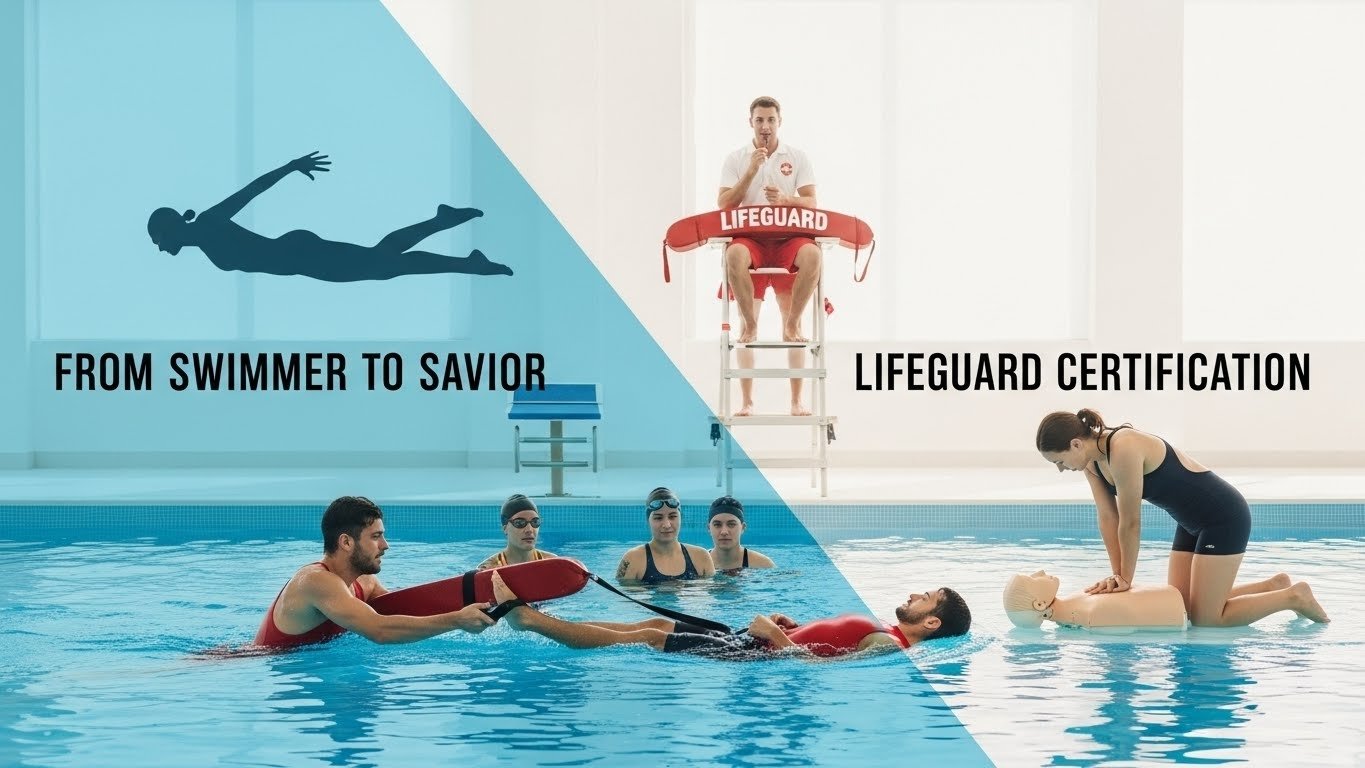
For the beachgoer, the sun-warmed wood of the stand, the faint smell of chlorine, and the constant rhythm of the waves are all components of an ideal day. But for the figure seated above it all, the lifeguard, this setting is a dynamic landscape of possible danger, a theatre of ongoing watchfulness. Framed against the summer sky, that classic silhouette is more than just a symbol of security; it is the ultimate result of a difficult and transforming path.
Officially starting with the quest for a single, vital certification—lifeguard training—the path to get the red buoy and the whistle is one of extreme physical conditioning, life-saving knowledge, and mental fortitude. Built into demanding lifeguard lessons, this process turns a competent swimmer into a protector of the water, ready to answer the call when times matter the most.
What is Included in a Lifeguard Certification?
The official document that confirms an individual’s capacity to carry out lifeguard responsibilities is their lifeguard certification. Rather than one test, it is a whole program with a broad spectrum of abilities and information. Consider it as a whole curriculum aimed at producing a responder as skilled in reaction as they are in prevention. Water rescue methods, cardiopulmonary resuscitation (CPR), and first aid comprise the core of any certification program.
The training goes well beyond these technical skills, though. It includes surveillance methods to actively stop crises, communication skills for interacting with the public and other employees, and the cultivation of a professional lifeguard’s mindset—responsibility, teamwork, and unflinching vigilance.
Where Can You Find Lifeguard Classes?
Potential lifeguards will find lifeguard training provided by several well-known groups. Local community pools, YMCAs, colleges, and private aquatic safety businesses often host these courses. Look for a provider approved by a reputable national body. One such front-runner in the field is the American Lifeguard Association, which establishes a strict standard for certification and training worldwide as well as in the United States. Searching for courses requires attention to a reputable and complete program among the aquatic community.
Usually self-paced, these programs are demanding, instructor-led courses needing perfect participation. Both theoretical in-classroom sessions, where pupils get taught the ideas of safety and emergency care, and practical, in-water sessions, where they physically rehearse rescue methods until they become second nature, define their structure. Candidates must pass preparatory swimming tests before even signing up for a class to prove they have the basic aquatic strength necessary for success in the training.
What are the Prerequisites for Enrollment?
Before a candidate can even step into the pool for training or the classroom, they have to show they have the fundamental physical abilities to meet the requirements of the role. The prerequisites aim to weed out candidates already well-grounded in swimming. What to study to become a lifeguard? While the initial focus is on physical prerequisites, the curriculum quickly expands far beyond them. Although the exact requirements differ somewhat among certifying organizations, they often comprise a number of swim examinations.
Typically, candidates must show not only ability but also endurance by swimming freestyle or breaststroke for 200 to 300 yards. The brick retrieval is yet another popular test in which the applicant must swim 20 yards, dive to a depth of 7 to 10 feet to recover a 10-pound item, then swim back to the starting point, keeping their face over water and carrying the brick with both hands. This models the physical difficulties of a rescue.
How Do Lifeguards Train for Water Rescues?
One usually thinks of a lifeguard performing a heroic rescue, but in reality, rescue methods are planned, learned, and geared toward safety. How to learn to be a lifeguard? It involves mastering a vast array of water rescue techniques, which takes up a major part of the training. Beginning with the basic rescue tube, which is a lifeguard’s main tool, trainees get instruction on many kinds of equipment. They train to approach an injured person, tether the victim with the tube, and tow them securely back to the wall or beach.
For a passive unconscious victim, the rescue must be quick and entail rapid in-water treatment for possible spinal damage. Until the motions become second nature, trainees repeat these scenarios in many different water circumstances so that they can react quickly and successfully under actual pressure.
What is the Role of CPR and First Aid in Lifeguard training?
Though water rescues make up an obvious component of the work, the medical education a lifeguard gets is most likely even more vital. What certifications do you need for a lifeguard? The answer is centered on comprehensive medical training. Whether it happens on the deck or in the water, a lifeguard is usually the first responder to a medical crisis. Therefore, CPR and first aid training comprise the foundation of their emergency care skills set. Especially designed for the professional rescuer is the CPR part of the certification. On adult, child, and infant manikins, trainees master superior chest compressions and rescue breathing.
At aquatic venues, AEDs—which are increasingly available—are used to train for; they can greatly improve the survival rate of a person going through sudden cardiac arrest. From little cuts and bruises to life-threatening ailments, including serious bleeding, shock, and spinal injuries, the first aid part of the training is thorough. Managing possible head, neck, and back injuries, which are a major danger in aquatic settings, is given especially great emphasis. With a backboard, trainees learn how to manually stabilize the spine and safely extricate a victim from the water—a difficult ability needing perfect collaboration among a team of lifeguards.
How is Professionalism and Vigilance Cultivated?
A qualified lifeguard is a professional charged with public safety rather than only a compilation of technical abilities. Thus, developing professionalism, awareness, and a proactive attitude is a vital but less concrete component of their training. Effective scanning is a systematic approach of observing their appointed zone of protection; trainees learn its fundamentals.
This is an active, spinning search strategy meant to find a possible victim in distress within seconds, mostly before they even have a chance to seek assistance, not a passive stare. This is the art of prevention, the final goal of every lifeguard.
What Does the Final Certification Evaluation Entail?
The outcome of all this rigorous effort is the ultimate certification assessment, a multifaceted test that assesses all aspects of the trainee’s abilities. Notoriously tough, this assessment gives little scope for doubt regarding a candidate’s preparation. Usually, it consists of three sections: a written test, a practical skills exam, and a scene-based simulation. Including first aid rules, CPR methods, rescue techniques, and professional responsibilities, the written test includes all the theoretical knowledge gained in the classroom.
The candidate must physically show ability in particular rescue methods, CPR sequences, and first aid applications on demand in the practical skills test. Usually, the most difficult segment is the scenario-based simulation when the instructor generates a simulated emergency like a multi-victim incident.
Then the candidate has to evaluate the scene, give victims top priority, implement the emergency action plan, and offer the necessary rescues and medical attention, all the while exhibiting a correct approach, clear communication, and calm leadership under duress. What can you do with a lifeguard certification? Passing this thorough examination, which validates your readiness for these real-world responsibilities, is the final step. The final stage in obtaining that much sought-after lifeguard certification is passing this thorough examination.
Why is Continuous Training and Recertification Necessary?
Once a lifeguard gets their first certification, their learning never stops. With fresh methods, tools, and studies appearing often, the field of water safety is always changing. Moreover, without training, physical and mental abilities can deteriorate. This is the reason that, typically, every two years, recertification is required.
It converts a powerful swimmer into a first responder, a knowledgeable rescuer, and a watchful guardian. Candidates obtain a lifeguard certification signifying not only a credential but also a pledge—a promise of competence, bravery, and a relentless dedication to safety, enabling everyone else to simply enjoy the water—through demanding lifeguard courses challenging both their minds and their bodies.